When people think about dog training, they often imagine teaching a command once or twice and expecting their dog to remember it forever.
But dogs don’t learn that way.
What is the Penny Jar Method in dog training?
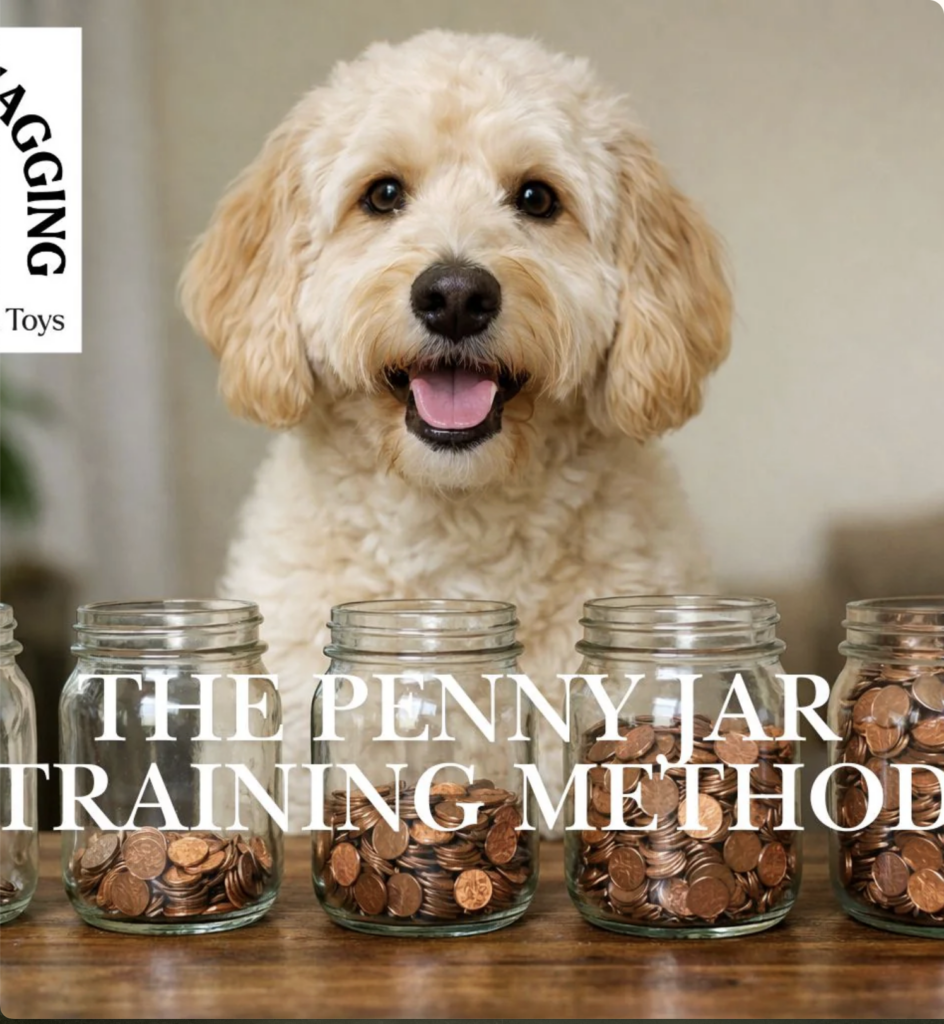
The Penny Jar Method is a simple way to think about repetition in dog training. Imagine every behavior your dog learns has its own jar. Each successful repetition adds a penny to that jar. The more successful repetitions your dog practices, the stronger and more reliable that behavior becomes.
A helpful way to understand how dogs really learn is something I call The Penny Jar Method to Dog Training. It’s a simple way to understand how dogs learn through repetition and positive reinforcement. Imagine every skill your dog learns has its own jar, and each time your dog successfully performs that skill, you add a penny to the jar. Over time, the jar fills with repetitions, making the behavior more reliable. If a behavior isn’t working well—like loose leash walking—it may simply mean the jar doesn’t have enough “pennies” yet.
Over time, those pennies start to add up.
How Dogs Really Learn: Repetition Builds Reliable Skills
Dogs learn through practice and positive reinforcement.
Each time your dog successfully performs a behavior, their brain strengthens that skill. In other words, you’re adding another penny to that training jar.
The more pennies in the jar, the more reliable the skill becomes.
But here’s an important question to think about:
After a month of living with your dog, which training jars would be full… and which ones would still be empty?
Why Most Dogs Have an Overflowing “Sit” Jar
For most dogs, the “Sit” jar is overflowing.
That’s because we ask for it all the time.
We ask our dogs to sit:
That jar fills up quickly because it gets dozens of repetitions every week.
Now ask yourself this:
If you practiced leash walking the same number of times you ask your dog to sit, how do you think your leash skills would be coming along?
Most likely, they would be much better.
Not because leash walking is easier—but because the jar would have far more pennies in it.
The “Empty Jar” Problem in Dog Training
One of the most common mistakes dog owners make is accidentally asking their dogs for empty-jar skills.
For example:
A dog owner might ask their dog to come when called at the park, but that jar only has a few pennies in it because recall hasn’t been practiced much at home.
Or they might expect their dog to walk politely past other dogs, even though loose leash walking has only been practiced a handful of times in quiet places.
From the dog’s perspective, the skill simply isn’t fully learned yet.
The jar isn’t full.
And when the jar is nearly empty, the behavior will often fall apart in real-life situations with distractions.
How to Fill Your Dog’s Training Jars
The solution is simple:
Practice more — and practice intentionally in everyday life.
Instead of only asking for behaviors when you need them, spend time building the skill first.
Here are a few easy ways to add more pennies to your dog’s training jars:
🐾 Practice recall inside your home several times a day.
🐾 Ask for sits before meals, doors, toys, and playtime.
🐾 Work on loose leash walking in your driveway or backyard first.
🐾 Play short training games that build focus and engagement.
Every successful repetition adds another penny.
Reliable Dog Training Takes Time
Over time, those pennies add up.
A jar that once held just a few coins becomes heavy with hundreds of successful repetitions.
That’s when training starts to feel easier.
Skills with full jars are much more reliable in real-world situations like:
Reliable dog training isn’t about luck. It’s about practice, consistency, and filling the jar.
A Simple Question That Can Improve Your Dog Training
The next time your dog struggles with a behavior, pause and ask yourself:
“Am I asking for a full-jar skill… or an empty-jar skill?”
If the jar is still empty, that’s okay.
It just means your dog needs more pennies, more practice, and more chances to succeed.
And every time your dog gets it right, you get to drop another penny in the jar. 🐾
About The Joy of Wagging
At The Joy of Wagging, I help dogs and their people build happy, successful lives together using positive reinforcement dog training. Through clear communication, practice, and patience, dogs can learn the skills they need to thrive in our human world. Visit our website and book a FREE Discovery Call today, and let’s get started learning how to fill those training jars.
If you’re looking for personalized help, learn more about my positive reinforcement dog training services in Medford, Oregon, at The Joy of Wagging.